How Much Do Custom Built-Ins Cost in Portland? What Actually Drives the Price


One of the most common questions about custom built-ins is also one of the hardest to answer accurately:
How much do they cost?
The answer depends on much more than size. Materials, fabrication methods, hardware, finish, complexity of the design, and the room itself can all have a significant effect on the final price.
Custom built-ins also generally cost more than stock or semi-custom cabinetry because they are developed and built for one particular space rather than produced from an established system. That additional cost buys something in return: more control over how the built-in fits, how it functions, what it is made from, and how it looks in the finished room.
That is why a simple price-per-foot number rarely tells the whole story.
How Size and Complexity Affect Custom Built-In CostA straightforward wall of open shelving will generally cost less than a built-in with doors, drawers, base cabinets, lighting, or other integrated features. Every added element means more material, hardware, machining, finishing, fitting, and installation time. A bank of drawers, for example, requires considerably more work than an open shelf occupying the same amount of space. Those features also make the built-in more useful. Open shelving can be used for books and display, while doors and drawers provide concealed storage. Hardware can be selected based on how the cabinetry will actually be used, and the layout can be designed around what you need to store rather than the cabinet sizes available from a product line. The more the built-in is expected to do, the more involved it becomes to build. But that additional complexity is also what allows it to solve more problems within the same space. |
How Materials and Finish Affect Cost and Appearance
Painted cabinetry, natural wood veneer, and solid hardwood all have different material and labor requirements. The species of wood, quality of the veneer, grain matching, edge details, and type of finish can all affect cost as well.
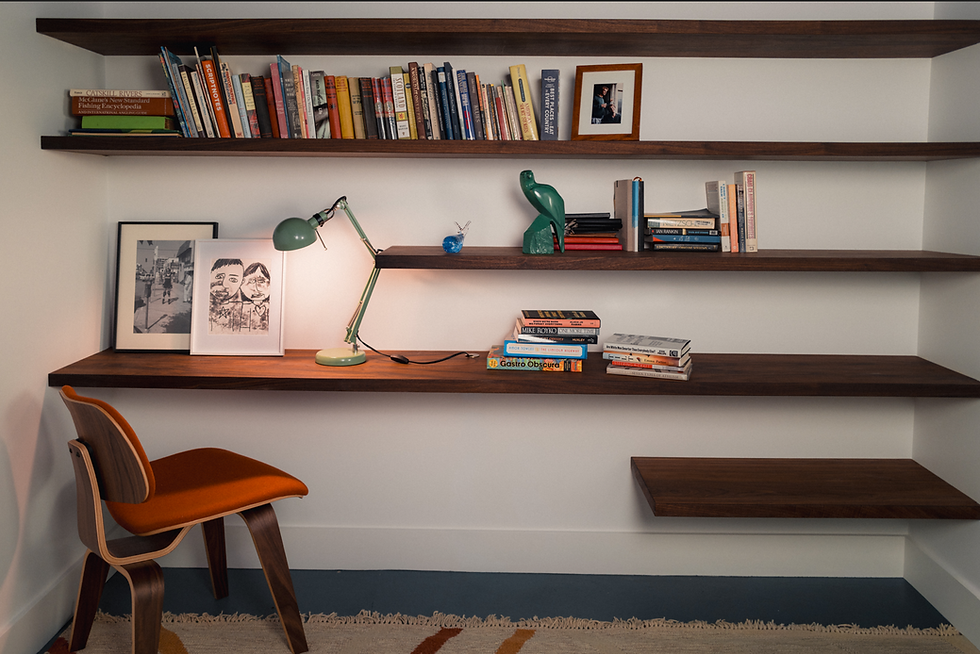
Those choices have a major effect on the finished room. A painted built-in might be designed to blend quietly into the space, while white oak, walnut, or another natural wood can become an important visual feature.
Custom work gives you much more freedom to make those decisions. You can select materials that work with the flooring, existing millwork, furniture, or overall character of the room rather than choosing from a limited group of standard finishes.
Spending more on a particular material or finish does not automatically make a project better. The value is having the ability to choose what is appropriate for the space and have it executed the way the design requires.

Why Custom Built-Ins Cost More Than Semi-Custom Cabinets
Semi-custom cabinetry begins with an established product. The cabinet sizes, construction methods, hardware options, and manufacturing process have already been developed, and the cost of that development is spread across hundreds or thousands of orders.
A custom built-in starts with a problem to be solved.
Before fabrication begins, there may be field measurements, design work, shop drawings, material and hardware selection, production planning, and one-off machining or setup. That work is being done specifically for a single project, so its cost cannot be spread across a larger product line.
That is part of why custom costs more, but it is also what gives it its flexibility. The cabinetry can follow the actual dimensions of the room, respond to an unusual condition, align with existing millwork, or accommodate a very specific combination of storage and display.
Instead of making the room work with a predetermined cabinet system, the cabinetry is developed around the room.
How Site Conditions Affect Custom Built-In PricingThe room itself can also affect the amount of work involved. Walls are not always straight, floors are not always level, and corners are not always square, especially in older Portland homes. A wall-to-wall built-in may need to be scribed to uneven surfaces, fitted around baseboards or casing, or carefully worked into a space beside a fireplace or window. Those details take additional time during fabrication and installation. They also make a visible difference in the finished project. A properly fitted built-in can use the entire available space and meet the surrounding room cleanly instead of leaving awkward gaps or relying on oversized filler pieces to make standard cabinets fit. That level of fitting is one of the areas where the additional labor of custom work can be easy to see. |
How Lighting and Integrated Features Affect Cost
Lighting, televisions, charging, concealed wiring, and audio equipment can all be incorporated into a built-in, but they require additional planning and coordination.
Accounting for those features before fabrication makes it possible to provide routes for wiring, locate equipment intentionally, and incorporate lighting without making it look like an afterthought.
That adds some cost to the project, but it can also produce a much cleaner result than trying to add those features after the cabinetry has already been installed.
When Custom Built-Ins Are Worth the Added CostNot every storage problem requires custom cabinetry. If the space is straightforward and a stock or semi-custom product provides the layout, materials, and appearance you want, it may be the more economical choice. Custom becomes more valuable when those options start requiring compromises. If you want to use a wall from end to end, work around unusual conditions, combine several types of storage, match existing details, use a particular material, integrate lighting or technology, or create something that feels permanent to the room, custom work gives you far more control over the result. That is ultimately what the added cost is paying for. It is not simply a more expensive way to build the same cabinets. It is the ability to create something that fits the space more precisely, works the way you need it to, and looks like it was designed specifically for your home. |
Custom Built-Ins in Portland
Rip City Craftsman designs, builds, finishes, delivers, and installs custom built-ins and architectural woodwork throughout Portland, Lake Oswego, West Linn, Raleigh Hills, Beaverton, Tigard, and surrounding communities.
Projects range from built-in bookcases and home offices to entertainment centers, fireplace built-ins, storage walls, and custom shelving. The final cost depends on the scope, materials, level of detail, and features involved.
If you are considering a custom built-in, photos of the space, approximate dimensions, and a few examples of the style you are looking for are usually enough to begin the conversation.


Comments